
Electronics

From controlling to measuring.

In the Soccer Electronics team we develop and design our own circuit boards. In addition, we test the solutions tailored for our robots and develop them further. For the design we use "KiCad" and "LTspice". Many of our circuits are quite complex, so we have to test them very extensively. We use our oscilloscopes for this purpose, for example.

Mikrocontroller

Our robot is controlled by several microcontrollers. Each module has its own microcontroller, which is responsible for the relevant control functions. The modules are connected to one another via a CAN bus to exchange control signals and current status information.

Kicker ("Automatix")

Concept

In the ‘soccer small size’ league, the robots play with a standard golf ball, which may be accelerated to a maximum speed of 6.5 m/s. This corresponds to a total kinetic energy of approximately 1 joule. From a wide range of options, we opted for an electromagnetic kicking mechanism, as this meets several key requirements, such as high reliability and a sufficiently high ‘shot rate’. 

Transformation

A flyback transformer charges two capacitors in less than a second. When the device is triggered, the energy stored in them is then channelled within milliseconds into a coil, which attracts a ferromagnetic pin. This pin then strikes the golf ball and accelerates it. During development, particular attention was paid to the implementation of safety features, such as a discharge circuit and a flashing LED, which warns of high voltages.

Light Barrier

The light barrier tells the robot and our software whether the robot currently has the ball in the dribbler. To do this, an infrared signal is sent from one side of the dribbler to the other. If the signal does not reach the other side, there is a ball in the dribbler, which is blocking the signal.

ESC ("Numalfix")

Our motor driver has a customised design that allows it to be seamlessly integrated into the gearbox. The motor is controlled by a microcontroller using Field-Oriented Control (FOC). Shunt resistors with dedicated differential amplifiers are used to measure the motor current. The position and speed of the rotor are determined by a combination of Hall sensors and a quadrature encoder.

Radio module

The radio module handles communication with the PC. It uses an SX1280 transceiver with a low-noise amplifier (LNA) and a transmit amplifier operating in the 2.4 GHz band. This technology enables us to send new commands to each robot 100 times per second, even at competitions with numerous sources of interference.

Mainboard

The all-rounder among the modules: the mainboard provides several slots for additional modules, such as the wireless module, and allows a Raspberry Pi to be connected for greater computing power. However, as well as simply connecting other modules, it also houses an Inertial Measurement Unit (IMU) for estimating the robot’s movement, as well as a buzzer and several interfaces, including an SD card reader and a USB-C socket.

Colour Recognition & LCD Display IX ("FELIX")

FELIX is built into the robot’s casing and communicates the current ID and team colour to the rest of the robot. The ID is set permanently, as it does not change. The team colour, on the other hand, must always be determined in real time. To do this, a colour sensor is used, which measures the current team colour through a small hole in the casing.

Verteilnix

The main function of this board is to switch the robot on and off and to monitor the battery. A low-power microcontroller is used for this purpose. Once the batteries have been inserted, this microcontroller waits for the on/off switch to be pressed. The power is then switched on for the entire robot. To ensure that our batteries do not fail, Verteilnix monitors the voltage of both batteries as well as the current supplied. Verteilnix also generates 5V for all other modules using a buck converter.

The Electronics-Team

Felix

Felix Lesch

Electronics Leader, Distribution Board
B.Sc. Geodesy and geoinformatics

Member since January 2023

Max K

Max Känner

Firmware, Motor Controller
M.Sc. Computer engineering

Member since November 2019

Loh

Yi Hang Loh

Team Identification, Radio
B.Sc. Electrical engineering and information technology

Member since November 2024

Amogh

Amogh Bhagare

Power Conversion
B.Sc. Mechatronics

Member since December 2023

Max Westermann

Max Westermann

Light Barrier
M.Sc. Mechatronics and Robotics

Member since May 2022

Rami

Rami Hoballah Jalloul

Sound
B.Sc. Electrical engineering and information technology

Member since April 2025
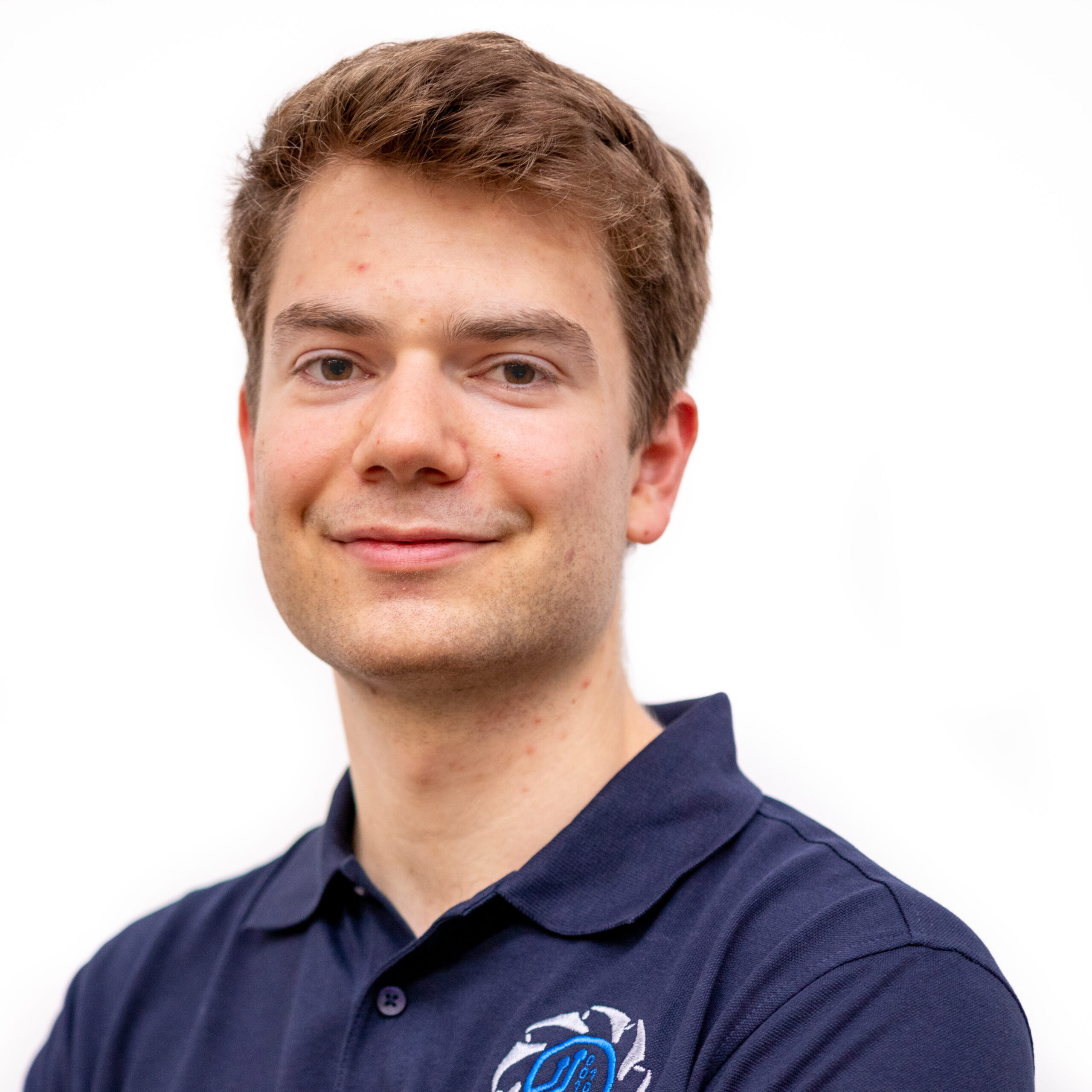
Timo de Vries

Timo de Vries

Kicker
M.Sc. Mechatronics and Robotics

Member since November 2019

Julian

Julian Schöning

Power Management
B.Sc. Electrical engineering and information technology

Member since June 2023
luhbots – Logo

Simon Keller

Mainboard, IMU
B.Sc. Mechatronics

Member since April 2025

luhbots – Logo

Kira Neugebauer

On/Off PCB
Voluntary Scientific Year

Member since December 2025

luhbots – Logo

Pio Stephen Alexander

Ballometer
B.Sc. Mechatronics

Member since December 2025

luhbots – Logo

Lorenz Pochler

Luhaisa, Flex PCB
B.Sc. Nanotechnology

Member since December 2025

Interested in joining the team?